

Alocasia ‘Dragon Scale’ & ‘Black Velvet’: The Allure of Dark Foliage Plants

Introduction
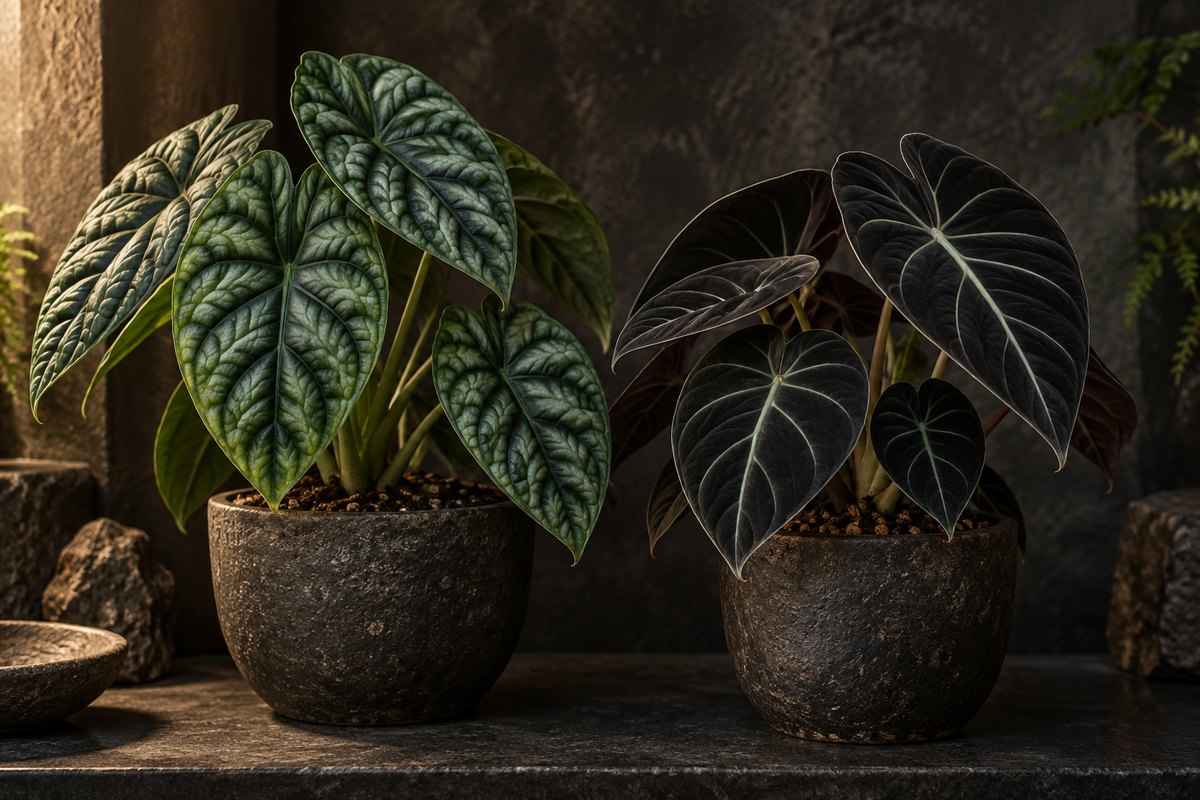
There’s a section of the archive I call “the dark corner”—the lighting is deliberately dimmed, the backdrop is a dark volcanic rock wall. Several plants sit there that make first-time visitors reach out to touch them. The leaves are thick as leather, with a metallic sheen, coloured so deep they’re nearly black, with faint silver-green veining visible only in the subdued light.
“Are these real plants?” some ask.
They are real. And they’re thriving—they just happen to look like species that wandered out of a fantasy novel.
These are Alocasia ‘Dragon Scale’ and Alocasia ‘Black Velvet’—two plants classified by enthusiasts as “dark aesthetic” foliage. They don’t compete with bright colours; instead, they conquer through texture, sheen, and an aura of mystery.
Dragon Scale: Armour Plated in Leaf Form
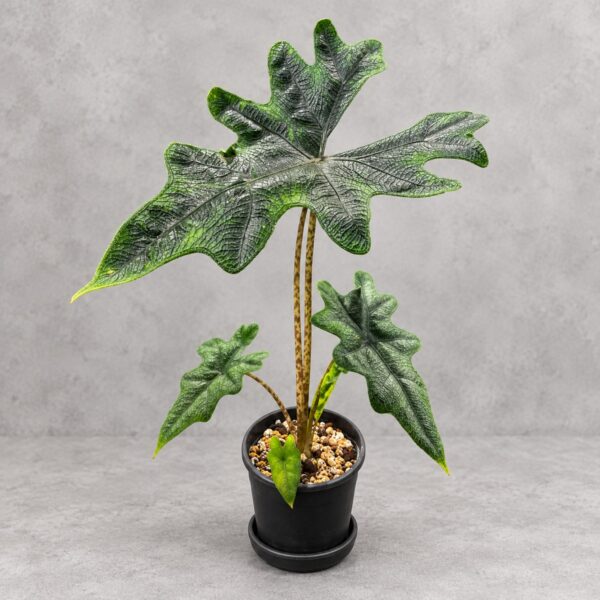
Alocasia ‘Dragon Scale’ produces ovate leaves that are thick and leathery, covered in fine, intricate texture. Under light, these surface details create subtle shadows that make each leaf resemble cast metal dragon scales—deep green base colour with lighter olive green in the sunken veins, while raised portions catch the light with a dark, subdued glow.
The most captivating moment is when a new leaf unfurls. Dragon scale new leaves emerge wrapped in a silvery-white sheath, slowly extracting themselves from the stem tip like a sword being drawn from its scabbard. That silver membrane gradually peels away, revealing the deep green “scales” beneath—a process that unfolds over several days, with subtle changes visible each morning and evening that keep you checking back obsessively.
Mature leaves can reach over twenty centimetres, with the whole plant growing forty to sixty centimetres tall. Though not a large plant, its commanding presence anchors any corner it occupies.
Black Velvet: A Feast for Fingers and Eyes
If the dragon scale’s power lies in its visual metallic texture, the black velvet alocasia is a master of touch.
Alocasia ‘Black Velvet’ leaves are similarly thick but covered in extraordinarily fine fuzz that feels exactly like genuine velvet—soft, warm, with an almost luxurious quality against your fingertips. The colour is an extremely deep forest green, appearing nearly pure black from certain angles, with only the veins retaining a crisp silver-white pattern that looks as if someone embroidered the venation onto dark velvet using silver thread.
The black velvet stays more compact than the dragon scale, typically reaching thirty to forty centimetres at maturity. It’s perfectly suited for desks, bedside tables, or office surfaces. It doesn’t need much space to make its presence felt—that single dark, velvety leaf draws attention wherever it sits.
Where Did “Dark Aesthetic” Come From?
The term “dark aesthetic foliage plants” (暗黑系觀葉植物) originated in Japanese horticulture circles before spreading globally via Instagram and plant trading platforms. It refers to plants with extremely dark leaves (approaching black or deep forest green), distinctive surface textures (fuzzy, metallic, waxy), and an overall mysterious, understated presence.
These plants typically evolved in the deepest rainforest understoreys, where light is barely a whisper. Darker leaves absorb light more efficiently, while specialised surface textures (fuzz or wax) help shed moisture or reduce fungal infection in perpetually damp environments.
In other words, “dark aesthetic” isn’t a human-imposed category—it’s the result of millions of years of nature refining life in the shadows.
Care Comparison: Dragon Scale vs. Black Velvet
The care logic for both is broadly similar, with a few subtle differences worth noting.
Light
Both prefer bright, indirect light but tolerate medium-light conditions. Black velvet handles lower light slightly better—it evolved in darker environments, and the fuzz on its leaves helps capture whatever faint light is available. However, prolonged insufficient light causes both varieties to produce thinner leaves with faded colour, losing that signature “dark” allure.
Water
Alocasias fear one thing above all: root rot. Both need exceptionally well-draining medium and strictly controlled watering. My rule: water only when the top two to three centimetres of soil are dry; during winter, stretch this to ten to fourteen days. Avoid getting water in the leaf crown, especially with black velvet—water trapped in the fuzz invites bacterial infection.
Humidity
Hong Kong has another advantage here. Both prefer humidity above 60%, and Hong Kong summers are practically paradise for them. During winter heating season, place a small water dish nearby or group plants together to raise local humidity.
Medium Recipe
I use nearly identical mixes for both: 40% peat moss + 30% perlite + 20% orchid bark + 10% charcoal. Only one thing matters: aeration, aeration, and more aeration. Alocasia roots need abundant oxygen; soggy, airless conditions are their greatest enemy.
Dormancy Management: The Alocasia “Winter Sleep”
This is the most confusing aspect for new alocasia growers. Every year from late autumn through early spring, both dragon scale and black velvet may enter dormancy—growth stops, leaves gradually yellow and drop, until only a bare corm remains buried in the soil.
Don’t panic. This is completely normal.
Dormancy is a natural physiological rhythm. As temperatures drop and daylight shortens, the plant redirects nutrients into its underground corm, waiting for spring to return. Here’s what to do:
1. Reduce watering: Once the soil is completely dry, occasionally trickle a small amount of water around the pot edge to prevent the corm from desiccating.
2. Stop fertilising: The dormant plant needs no nutrients.
3. Keep cool: 10-18°C is ideal—avoid placing near heaters.
4. Wait patiently: When spring warmth returns, new shoots will naturally emerge from the corm. Resume normal watering and feeding then.
Interior Styling Recommendations
Dark aesthetic alocasias shine brightest in minimalist, modern, industrial, or wabi-sabi spaces. Cement walls, dark wood, black metal shelving—these elements perfectly complement the textures of dragon scale and black velvet.
Conversely, if your home follows a cosy cottage style with lots of florals and pastels, dark alocasias may feel out of place. Of course, there are no absolute rules in gardening, and unexpected combinations sometimes create the most striking results. But if you want maximum visual impact, dark, clean backgrounds are the ideal canvas.
Conclusion
Dragon scale and black velvet alocasias aren’t “cute” plants that make you fall in love at first sight. Their appeal is more like a mysterious character from a classic film—understated, restrained, yet increasingly captivating the longer you observe. When you study that single dark leaf catching the lamplight at midnight, the metallic sheen or velvety texture suddenly makes perfect sense of why so many plant lovers reserve the best spots in their homes for these living sculptures.
If you’d like to experience the dark aesthetic in person, Plantjai’s Causeway Bay store carries both dragon scale and black velvet alocasias in stock, from seedlings to mature specimens. Our archive staff will teach you how to recognise dormancy signs and prepare the ideal growing medium. Or browse plantjai.com first to see them in photographs—though photos can never fully convey the real textures, they’ll give you a sense of what beauty awaits.
The dark corner’s lights are always on for these plants. Step inside, run your fingers across those dragon scales, feel that black velvet.
IN STORE NOW
Plants for this guide
Related plants in stock now — live prices, delivery or Causeway Bay pickup.
FREE PLANT ADVICE
Send us a photo before you change anything
WhatsApp a photo of the plant and your window light. Our Causeway Bay team will suggest care steps or plants that suit your space.
STORE · CAUSEWAY BAY
4/F, 39 Yiu Wa Street, Causeway Bay
Daily 12:30–8:00pm · ~3 min walk from Times Square
Map & directions