
How to Care for Ficus Elastica Variegata in Hong Kong | Plantjai


Plantjai 植仔 · Care Encyclopedia
Ficus Elastica Variegata
Ficus elastica 'Shivereana' 雀斑印度榕
Hong Kong care guide — useful before you buy and after it arrives.
Shop this plantA canvas of cream, jade, and deep green woven across broad leaves — a single specimen becomes the focal point of any living room, a timeless classic in large indoor foliage.
Origin & characteristics
The variegated rubber plant is a naturally occurring variegated form of Ficus elastica, whose parent species is native to the tropical rainforests of South and Southeast Asia, including India, Myanmar, Thailand, Malaysia, and Indonesia, and belongs to the fig family (Moraceae). As an evergreen tree, it can reach 30 metres in the wild, but potted specimens typically stay in the 1–2 metre range, making it a classic large-scale indoor foliage plant.
Key characteristics:
- An evergreen tree, typically 60–200 cm in pots, growing upright with a dense canopy
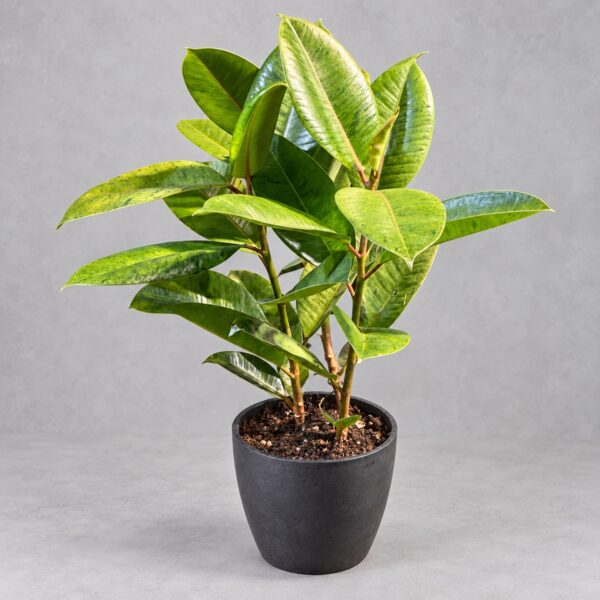
- Broad, elongated-oval to ovate leaves, thick and leathery with a glossy finish, up to 30 cm long
- The variegated form displays irregular cream, pale yellow to pale green patches against a deep green background, in striking contrast
- New leaves emerge wrapped in a reddish-brown sheath, with the unfurling process itself highly ornamental
- Well-developed aerial roots; mature plants often show roots growing along the trunk
- ⚠️ Toxicity note: the sap contains an irritant latex (ficin enzyme and furanocoumarins); ingestion can cause oral burning, vomiting, and diarrhoea, skin contact may cause redness and allergic reactions, and eye contact can be seriously irritating. Always wear gloves and eye protection when pruning, and keep the plant completely out of reach of children and pets
Light
- Ideal light: bright, indirect light to partial direct sun (east-, southeast-, or south-facing windows with a sheer curtain all work)
- Variegated cultivars need adequately bright light to maintain their patterning — insufficient light causes the variegation to fade back toward solid green
- Can tolerate gentle morning light from an east-facing window, or a position 2–3 metres back from a south-facing window
- Avoid prolonged intense direct sun, especially at midday in summer, which can scorch the leaf edges
- If indoor light is insufficient, consider a grow light for 6–8 hours a day
- Rotate the pot a quarter turn every one to two weeks for balanced growth
Watering
- Principle: let it dry out fully before watering, never let the base sit in standing water
- Spring/summer growing season: water once the soil has dried 3–5 cm down, roughly every 7–10 days (adjust for temperature and humidity)
- Autumn/winter dormant season: reduce to roughly every 10–14 days, confirming dryness with a finger test before watering
- Each time, water slowly and thoroughly until it drains from the base, then always empty the saucer within 30 minutes
- For larger pots, try the "soak method": submerge the pot in shallow water for 10–15 minutes and let the soil absorb naturally
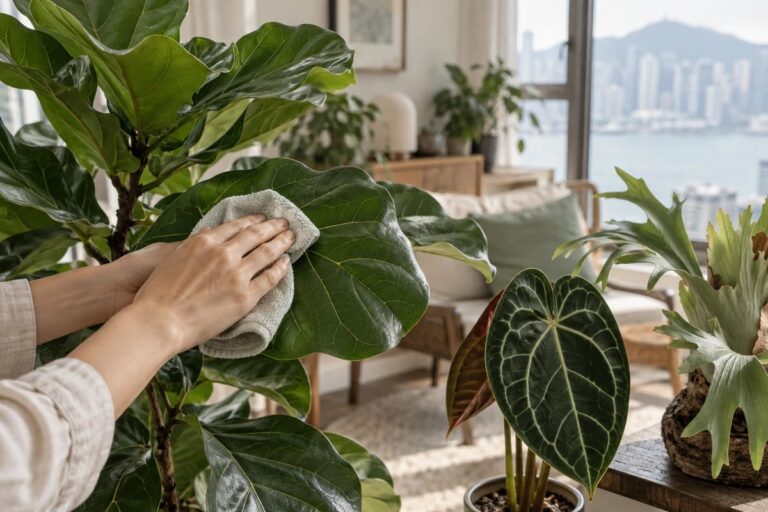
- Wipe the leaves regularly with a slightly damp cloth to remove dust, keeping them glossy and able to breathe
- Note: variegated rubber plant roots strongly dislike prolonged waterlogging, which quickly leads to root rot
Soil & pot
- Soil recipe: needs good drainage and aeration, suggested ratio:
- General potting soil 50% + perlite 25% + coco chunks or pine bark 20% + charcoal chips 5%
- pH: slightly acidic to neutral (6.0–7.0)
- Pot selection:
- Must have drainage holes; terracotta, concrete, or glazed pots all work
- For larger specimens, a heavier concrete or ceramic pot adds stability
- Being slightly pot-bound helps control growth rate — don't rush to size up
- When repotting, choose a new pot 2–3 inches (5–8 cm) wider in diameter
- Repotting timing: spring (March–May), roughly every 2–3 years, or once roots emerge from the drainage holes or the soil dries unusually fast
- Hold off on feeding for 4–6 weeks after repotting to let the roots recover
Temperature & humidity
| Item | Ideal range | Notes |
|---|---|---|
| Temperature | 18–30°C | Never below 10°C; growth stalls below 15°C for extended periods |
| Humidity | 50–70% | Higher humidity brings out richer leaf colour |
- Variegated rubber plant is fairly sensitive to temperature swings — cold drafts can cause extensive leaf drop
- Keep it away from AC vents, doorways, elevator entrances, and heaters
- Watch temperature changes closely during the autumn-to-winter transition — a sudden drop can cause yellowing and leaf loss
- In dry seasons (winter with heating on), use a humidifier, or group plants together to create a shared humid microclimate
- Regular misting helps raise humidity, but ensure good airflow afterward to prevent mould
Common problems
| Issue | Cause | Solution |
|---|---|---|
| Extensive leaf drop | Large temperature swings, relocation, cold drafts | Keep its position stable, away from AC/heater vents |
| Fading or disappearing variegation | Insufficient light | Move closer to a window for brighter indirect light, or add a grow light |
| Brown, scorched leaf tips | Air too dry / hard water / fertiliser too strong | Increase humidity, let tap water settle overnight, dilute fertiliser to half strength |
| Soft, drooping leaves | Overwatering causing root rot, or underwatering | Check soil moisture; if too wet, stop watering and ventilate; if too dry, gradually rehydrate |
| Small new leaves, stalled growth | Insufficient nutrients or root-bound pot | Feed monthly with diluted liquid fertiliser during the growing season, or repot in spring |
| Yellow-brown spots on leaves | Sunburn or bacterial leaf spot | Move away from strong light, improve ventilation, trim severely affected leaves |
| Leggy stems, wide leaf spacing | Severe light deficiency | Gradually increase light intensity, prune leggy growth |
| Brown speckling with insect residue on leaf undersides | Scale insect infestation | Wipe with an alcohol-soaked cotton swab, or treat with neem oil/dedicated insecticide |
| Soft, foul-smelling stem base | Root rot (overwatering) | Stop watering immediately, check roots, trim rot and repot in fresh soil |
How to explain to customers
The variegated rubber plant is a classic large-scale indoor plant — its big, bold leaves with cream and deep green marbling make a real statement, and a single specimen is enough to give any living room a sense of presence. It's fairly easy to care for; the most important thing is "let it dry before you water" — never water it every single day, as waterlogging causes real trouble. It likes light, and since it's variegated it needs a bit more of it to look its best — a window with natural light works well, but avoid direct sun in summer. In winter, watch the humidity when the heater's running, since dry air can brown the leaf tips. And a final reminder — the sap is toxic, so keep it well away from kids and pets, and wear gloves when pruning. Repotting can wait for spring, and every two to three years is plenty.
Fun facts
- The species name "elastica" comes from its elastic, latex-rich sap, which was historically used to manufacture rubber products.
- The rubber plant is one of India's national trees (alongside the sacred fig), symbolising longevity and prosperity, and is commonly planted around temples and palaces.
- The variegated pattern is essentially a "natural artwork" caused by chlorophyll loss, with the marbling on every leaf distributed at random.
- The rubber plant was one of the first tropical foliage plants introduced to Europe during the Victorian era (1837–1901), when it was known as the "India Rubber Plant."
- NASA research in the 1950s confirmed that the rubber plant effectively removes indoor formaldehyde and other volatile organic compounds, earning it a reputation as a "natural air freshener."
Keywords
Variegated rubber plant, Ficus elastica variegata, Indian rubber tree, variegated rubber tree, rubber plant, large indoor plant, variegated plant, foliage plant, indoor potted plant, Hong Kong indoor plants, Plantjai, air-purifying plant, pet-unfriendly plant, toxic plant, classic indoor plant
Plantjai · Causeway Bay collector indoor plants · WhatsApp +852 66807550
Plantjai shop · In stock online
Ficus elastica 'Shivereana'
Ficus elastica 'Shivereana'
from HK$198.00
Hong Kong delivery · Causeway Bay pickup
For Hong Kong homes and offices. Stock and pricing follow the product page.
IN STORE NOW
Plants for this guide
Related plants in stock now — live prices, delivery or Causeway Bay pickup.
Ficus elastica 'Shivereana'
Ficus elastica 'Shivereana'
from HK$198.00
In stock · store pickup
View plant
FREE PLANT ADVICE
Send us a photo before you change anything
WhatsApp a photo of the plant and your window light. Our Causeway Bay team will suggest care steps or plants that suit your space.
STORE · CAUSEWAY BAY
4/F, 39 Yiu Wa Street, Causeway Bay
Daily 12:30–8:00pm · ~3 min walk from Times Square
Map & directionsPlant Care