
How to Care for Alocasia Ninja in Hong Kong | Plantjai

Plantjai 植仔 · Care Encyclopedia
Alocasia Ninja
Hong Kong care guide — useful before you buy and after it arrives.
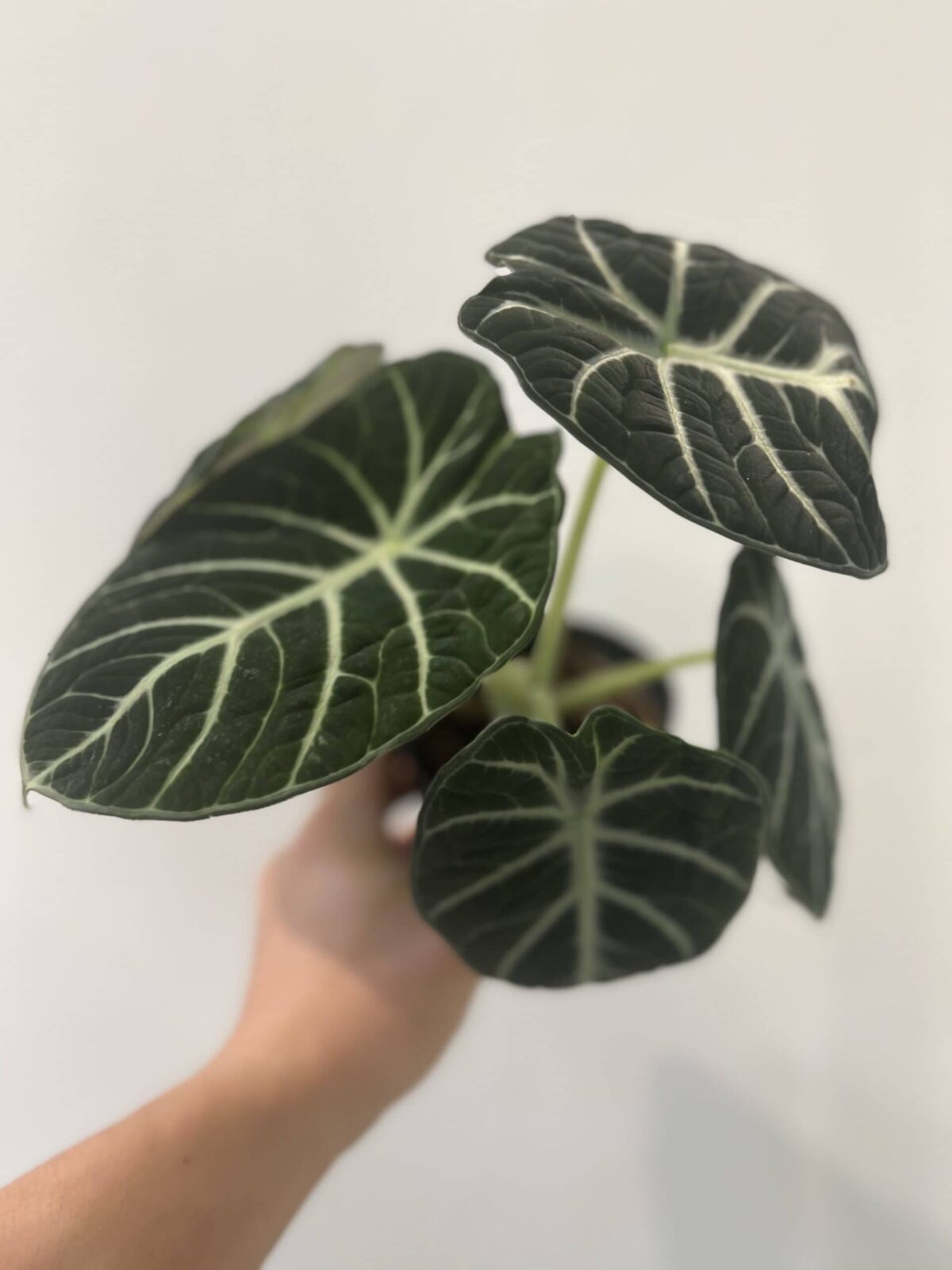
Shop this plantDeep velvet-green leaves with a double silver-white edge — a sleeker, more dramatic cousin of Black Velvet.
Origin & characteristics
Ninja Alocasia is a select cultivar of Alocasia reginula (the species behind Black Velvet), native to the limestone forest floor of Sabah and Kalimantan, Borneo. Its small, shield-shaped leaves are deep to dark green with a plush velvet texture, but its most distinctive feature is a double silver-white margin tracing the leaf edge, paired with a central silver vein — the striking light-and-dark contrast is exactly what gives it the name "Ninja." Mature plants stay small, just 25–40 cm, making it a perfect fit for a desk or plant cabinet.
Light
Prefers bright, indirect light — an east- or north-facing sill is ideal. A spot 1–2 m from a window with a sheer curtain is plenty. The velvety leaf surface is sensitive to direct light, and afternoon summer sun can scorch it easily. Too little light fades the silver veining and causes leggy, stretched growth. In a plant cabinet, LED supplemental lighting for 12–14 hours daily works well.
Watering
Water once the top 1–2 cm of soil has dried, keeping the mix evenly lightly moist but never waterlogged. This species has fine roots that are extremely sensitive to sitting in water, and rot is difficult to reverse once it sets in. Reduce watering further in winter. Use room-temperature filtered or rested water to avoid shocking the roots.
Soil & pot
Needs a highly aerated aroid mix: 40% coco coir, 30% perlite, 20% pine bark, 10% activated charcoal, at a pH around 6.0–6.5. Choose a pot with drainage holes; a small, clear nursery pot is handy for monitoring root health. This species prefers being slightly root-bound, so repotting is only needed every 1.5–2 years.
Temperature & humidity
Ideal range is 20–28°C; growth slows below 16°C, with real cold damage risk below 12°C. Humidity of 60–80% is ideal; below 50%, leaf tips dry out and leaves may curl. A plant cabinet, humidifier, or pebble tray all help, and it should always be kept away from AC vents and heaters.
Common problems
- Yellowing, dropping leaves: almost always overwatering and root rot — check the roots immediately, trim any rot, and repot into fresh, dry mix.
- Brown, crispy leaf tips: low humidity or hard water — raise humidity and switch to filtered water.
- Loss of velvety sheen: could be sun scorch or spider mites — check the leaf undersides and move away from direct light if needed.
- Stalled growth: may be dormancy or a root-bound pot — reduce watering in autumn and let it rest, or check if it's time to repot.
How to explain to customers
"Ninja is essentially Black Velvet's more dramatic sibling — it has this striking double silver line running along the leaf edge that you won't find on any other variety. It stays genuinely small, so it's perfect for a desk or plant cabinet, but Hong Kong's dry indoor air means a humidifier will really help it thrive."
Fun facts
The species name reginula is Latin for "little queen," a naming tradition shared with Alocasia reginae (Queen Alocasia) and Alocasia baginda (Indonesian for "Your Majesty") — together forming a loose "royal family" among Alocasia names. The deep velvet texture on Ninja's leaves comes from extremely fine hairs covering the surface, the same feature responsible for its rich, dark sheen.
Keywords
Ninja Alocasia, Alocasia Ninja, Alocasia reginula, Black Ninja, jewel Alocasia, dark velvet Alocasia, small houseplant, collector plant, toxic to pets, double vein, bright indirect light, high humidity, well-draining soil
參考資料(想知來源可展開)
References
- Plants of the World Online (Kew) — Alocasia reginula. https://powo.science.kew.org
- RHS — Alocasia care. https://www.rhs.org.uk/plants/alocasia
- The Spruce — How to Grow and Care for Alocasia Black Velvet. https://www.thespruce.com/how-to-grow-and-care-for-alocasia-black-velvet-5235406
⚠️ Pet / toxicity note: Contains calcium oxalate crystals throughout the plant; ingestion causes oral pain, swelling and digestive upset. Keep away from pets and small children, and wash hands after handling.
In-depth care guide
Introduction
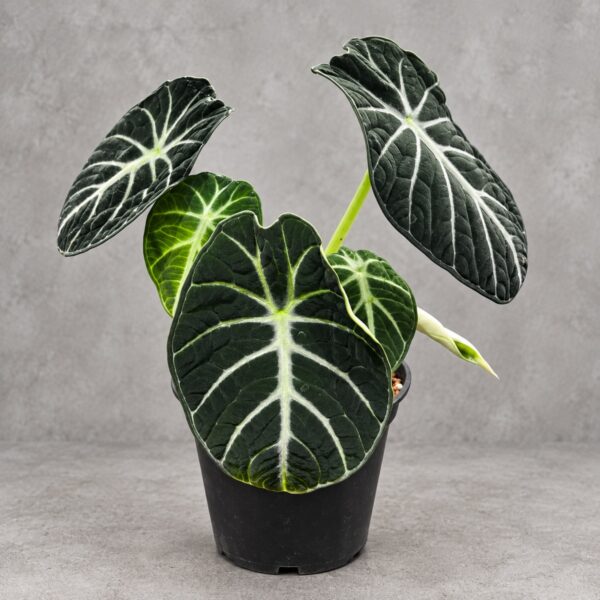
Ninja Alocasia (Alocasia reginula 'Ninja') is a highly collectible tropical foliage plant in the Araceae family, native to the rainforests of Borneo. It's a close relative of the widely known Black Velvet Alocasia (Alocasia reginula 'Black Velvet'), but the two are visually distinct — Ninja's leaves are generally more rounded and compact, with a thicker texture, and most notably feature dual marginal veins, forming a striking bright border around every leaf edge. This is the single clearest difference from Black Velvet, which has only a single, thinner white vein.
Ninja belongs to the informal "jewel Alocasia" group, staying small and compact — mature plants typically reach 30–45 cm — making it ideal for tabletop or shelf display in even the most space-limited Hong Kong home. Its deep green, velvet-textured leaves paired with contrasting silver-white venation create a genuinely understated but luxurious visual effect, explaining why it's become such a sought-after plant among serious foliage collectors.
Native habitat & growth habit
Ninja Alocasia is native to the lowland rainforest floor of Borneo, long adapted to warm, humid, filtered-light conditions. In the wild, it grows on well-drained forest litter, with roots needing plentiful airflow while staying reliably moist. Growth rate is moderate — under ideal conditions, expect 3–5 new leaves a year, though growth slows or pauses through cooler, dimmer months.
Like other Alocasias, Ninja stores energy in a shallow, laterally spreading rhizome rather than a deep vertical tuber. This anatomical detail matters for soil choice: if the growing medium is too dense or waterlogged, the rhizome can begin suffering oxygen deprivation and rot within as little as 36 hours.
Light requirements
Ninja needs bright, indirect light to maintain healthy growth and dark leaf colour. In its native environment, it grows beneath a dense canopy, accustomed to filtered light passing through multiple layers of foliage. Indoors, place it near an east- or west-facing window, roughly 90–120 cm from the glass, ensuring plenty of light without risking direct sun scorch.
A rough target is 700–1,000 foot-candles (about 7,500–10,000 lux) of indirect, diffused light — a phone-based lux meter app can help you gauge this reasonably well.
Avoid these two extremes: direct sunlight, where even filtered morning or western light exceeding about 1,200 foot-candles for more than 45 minutes can cause translucent, papery dead patches within 48 hours — damage that doesn't reverse; and excessively low light, which causes stretched petioles (etiolation), thinner leaves, and silver veining fading toward dull grey.
If natural light is insufficient, a full-spectrum LED grow light (3,000K+) run about 12 hours a day, positioned 45–55 cm above the plant, works well. Avoid cooler white LEDs below 3,000K, which can suppress chlorophyll synthesis in this species.
Watering and moisture management
Ninja prefers evenly moist soil that never becomes waterlogged. The most common mistake new growers make is watering on a fixed schedule rather than checking actual soil moisture.
The finger test: insert a finger 2.5–5 cm into the soil; water only once it feels dry, and wait a few more days if it's still damp.
Watering technique:
- Use room-temperature filtered water or rainwater (tap water with TDS above roughly 100 ppm can cause tip burn and browning edges over time).
- Water slowly until it runs from the drainage holes, then empty the saucer within five minutes.
- Never let the pot sit in standing water — this is the single biggest cause of rhizome rot.
- Water in the morning (between 8am and noon) rather than in the evening, to avoid the rhizome sitting wet overnight.
Seasonal adjustment:
- Spring/summer growing season: roughly every 4–7 days, depending on humidity and temperature.
- Autumn/winter dormancy: when temperatures drop below about 18°C or light weakens, extend the interval to every 7–10 days or longer, and be extra cautious about overwatering during this slower phase.
Soil & potting requirements
Ninja needs an exceptionally well-draining, highly aerated substrate. Standard peat-based potting mixes are typically too heavy and moisture-retentive, risking root oxygen deprivation.
Recommended soil mix:
- 35% coarse perlite (¼-inch grade, thoroughly rinsed)
- 25% orchid bark (medium-coarse, ⅜–½ inch)
- 25% quality peat-free potting soil or coco coir
- 10% horticultural charcoal (non-activated)
- 5% worm castings or slow-release organic fertiliser
Pot selection:
- Material: terracotta is strongly recommended over plastic — its breathability helps wick away excess surface moisture and moderates temperature swings.
- Size: choose a pot only 2.5–5 cm larger in diameter than the root ball. Ninja prefers a slightly snug root environment, and an oversized pot risks prolonged soil dampness.
- Depth: avoid pots deeper than about 15 cm, since the rhizome sits within the top 7–8 cm of soil.
- Drainage: drainage holes are absolutely essential.
Repotting: once every 1–2 years in spring is sufficient, or whenever roots emerge from the drainage holes. At repotting, check rhizome health — it should be firm and pale, with no translucent or soft brown patches (an early sign of rot).
Humidity requirements
Ninja likes moderate-to-high humidity, ideally 60–80%. Below 40% relative humidity, leaf tips and margins tend to dry out and turn brittle.
Effective ways to raise humidity:
- Humidifier: an ultrasonic cool-mist unit run at low output (150–200 mL/hour), placed about 90 cm from the plant, angled away from direct foliage contact to avoid condensation buildup.
- Pebble tray: a shallow tray of clean pebbles topped with water just below the surface, with the pot sitting on top (never touching the water). This can raise local humidity by 15–25%.
- Grouping plants: placing 3–5 humidity-loving plants (ferns, calatheas, peperomias) together creates a natural humid microclimate.
- Humidity dome: for smaller specimens (under 30 cm), a clear acrylic cloche with 3–4 small ventilation holes drilled at the base, monitored with a digital hygrometer, works well.
Avoid:
- Spraying water directly onto the leaves, which washes away the protective waxy coating and can trigger fungal leaf spot.
- Overly enclosed, poorly ventilated high-humidity setups, which encourage mould and fungal growth.
Temperature requirements
Ninja prefers warm, stable conditions — ideal daytime temperatures of 20–28°C, with nighttime lows no lower than about 16°C. Sustained temperatures below 15°C push the plant into dormancy, and below 10°C risks irreversible cell membrane damage.
Temperature management:
- Keep away from AC vents, heaters, and frequently opened doors/windows.
- In winter, use a thermostatically controlled space heater rather than a radiant heater to maintain stable ambient temperature (18–22°C).
- Above 30°C, even at 75% humidity, transpiration can outpace water uptake, causing heat-stress spotting on leaves.
- Stability matters more than any specific number — Ninja reacts poorly to sudden temperature swings.
Feeding
Ninja is native to nutrient-poor tropical forest floor and has correspondingly modest fertiliser needs. Overfeeding is a more common problem than underfeeding, leading to salt buildup, root tip damage, and leaf injury.
Feeding recommendations:
- Feed only during active growth (April–September), every 4–6 weeks.
- Use a balanced, water-soluble fertiliser (such as 20-20-20 or 9-3-6), diluted to a quarter strength.
- Apply only when the soil is already moist — never on dry soil, which risks root burn.
- Stop feeding entirely in autumn and winter. If new leaves take more than about 18 days to unfurl, or leaf margins start feeling brittle, pause feeding altogether.
- Flush the soil with three times the pot's volume of distilled water every 8 weeks to remove accumulated fertiliser salts.
Avoid: slow-release fertiliser pellets (which create toxic high-salt microzones near the rhizome) and foliar feeding (the upper leaf surface has almost no functional stomata for absorption).
Dormancy management
Ninja may enter partial dormancy in cooler, dimmer months — a completely normal physiological response.
Signs of dormancy:
- No new leaf growth for 45+ days
- Existing leaves stay plump, healthy-coloured, and undamaged
- Soil dries more slowly than usual
Dormancy care:
- Reduce watering frequency, but never let the soil dry out completely
- Maintain humidity above 50%
- Stop fertilising entirely
- Avoid repotting during this period
- Only prune if leaves are visibly yellowing or browning
Growth naturally resumes once day length exceeds about 11 hours and temperatures stay above 18°C for five or more consecutive days.
Propagation
Ninja is propagated primarily through rhizome division — leaf or petiole cuttings will not root, since all growth tissue is concentrated at the rhizome tip.
Rhizome division steps:
- Wait until the mother plant has at least 5 mature leaves with a visibly swollen rhizome.
- In mid-spring (mid-March to early April), gently remove the plant from its pot and rinse soil from the roots with lukewarm water.
- Using a sterilised single-edge blade, cut the rhizome vertically — each division must include at least one visible growth bud (a small pink protrusion) and at least two healthy roots.
- Dust the cut surface with sulfur powder (not cinnamon or neem oil, which can inhibit healing).
- Plant immediately into pre-moistened soil mix, burying the rhizome no deeper than about 1.3 cm.
- Place in a sealed clear plastic bag with 3–4 ventilation slits; maintain 24–26°C, away from direct light, for 21 days.
Root systems typically establish within 28–35 days. Avoid watering again until you see new leaf growth. Following this method, success rates can exceed 90%.
Common problems and solutions
Yellowing leaves: if the top 5 cm of soil is dry, this points to underwatering — increase watering frequency. If the soil is moist, it's likely overwatering causing rot — reduce watering and check the roots, trimming away any rotten tissue with sterilised scissors before replanting in dry, fresh soil.
Leaves folding downward ("praying" posture): indicates acute water stress rather than a light issue. Soaking the pot for 15 minutes usually reverses this within 4–6 hours; persistent folding suggests chronic low humidity or root-bound conditions.
Stalled growth with small, pale leaves: almost certainly insufficient light rather than a nutrient deficiency. Move the plant closer to a light source or add supplemental lighting — don't fertilise, which will only worsen the imbalance.
Black, oily spots on leaves: possibly a Phytophthora-related fungal infection. Remove affected leaves immediately, improve air circulation, stop misting leaves, and treat with a copper-based fungicide, repeating after 7 days if needed.
Brittle, browning leaf edges: low humidity. Use a humidifier or move the plant to a more humid environment.
Toxicity
Like all Araceae family members, Ninja contains insoluble calcium oxalate crystals. Ingestion causes oral irritation, swelling, and difficulty swallowing. It's toxic to both pets (cats, dogs) and children — keep it well out of reach. If ingestion occurs, rinse the mouth with water and contact a vet or poison control centre immediately. Gloves are recommended when handling the plant, since the sap can irritate sensitive skin.
References
- Plants of the World Online (Kew) — Alocasia reginula. https://powo.science.kew.org
- RHS — Alocasia care. https://www.rhs.org.uk/plants/alocasia
- The Spruce — How to Grow and Care for Alocasia Black Velvet. https://www.thespruce.com/how-to-grow-and-care-for-alocasia-black-velvet-5235406
- Wikipedia — Alocasia. https://en.wikipedia.org/wiki/Alocasia
- Proven Winners — How to Grow Alocasia Indoors and Outdoors. https://www.provenwinners.com/learn/houseplants/alocasia
Plantjai shop · In stock online
Alocasia 'Ninja'
Alocasia 'Ninja'
from HK$138.00
Hong Kong delivery · Causeway Bay pickup
For Hong Kong homes and offices. Stock and pricing follow the product page.
IN STORE NOW
Plants for this guide
Related plants in stock now — live prices, delivery or Causeway Bay pickup.
FREE PLANT ADVICE
Send us a photo before you change anything
WhatsApp a photo of the plant and your window light. Our Causeway Bay team will suggest care steps or plants that suit your space.
STORE · CAUSEWAY BAY
4/F, 39 Yiu Wa Street, Causeway Bay
Daily 12:30–8:00pm · ~3 min walk from Times Square
Map & directionsPlant Care