
How to Care for Alocasia Frydek Albo Large in Hong Kong | Plantjai

Hong Kong care guide for Alocasia Frydek Albo Large.
Velvet green leaves draped in white marbling, at full mature size — a genuine centrepiece for a serious collection.
Origin & characteristics
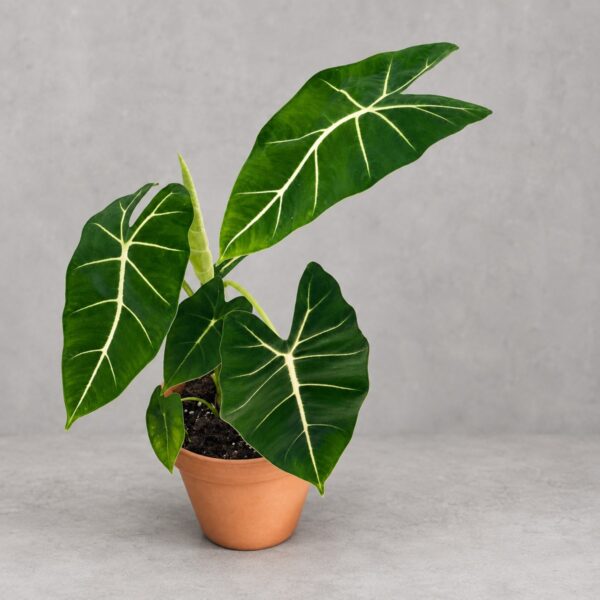
This is a large, well-established specimen of Alocasia micholitziana 'Frydek Albo', the variegated form of Green Velvet Alocasia native to the montane cloud forests of the Philippines. 'Frydek' is the horticultural name given to the species after its introduction to Europe, prized for deep green, velvet-textured leaves with bold white venation; the Albo form adds irregular white or cream marbling across the leaf itself. The "Trichoma" — the fine hairs across the leaf surface — give it a soft, plush sheen under light. Leaves on a large specimen can reach 30–40 cm long, delivering serious visual impact and making it one of the more advanced, statement-piece Alocasias in the trade.
⚠️ Toxicity note: This plant contains calcium oxalate crystals and alkaloids and is considered more strongly toxic than many houseplants. Ingestion can cause severe oral burning, swelling, drooling, vomiting, and in serious cases throat swelling that affects breathing. Skin contact with the sap can cause redness, blistering, or allergic reaction. Wear gloves when handling, and keep it strictly away from children and pets.
Light
Needs bright, indirect light. Because the white variegated portions lack chlorophyll, adequate light is essential to sustain both healthy growth and pattern intensity.
- Ideal placement: 0.5–1 m from an east- or north-facing window; a south/west window needs a sheer curtain or blinds to filter direct rays.
- Daily exposure: at least 6 hours of bright, indirect light.
- Signs of good light: deep, glossy velvet-green leaves, crisp white variegation, healthy new-leaf unfurling.
- Signs of insufficient light: thin, soft leaves, dulling colour, fading variegation, stalled growth.
- Avoid: any direct strong sun — the velvety leaf surface burns very easily, leaving permanent brown scorch marks.
- Tip: rotate the pot regularly so all sides receive even light, keeping the plant's form balanced and attractive.
Watering
Follow the principle of "let the topsoil dry fully, then water thoroughly." Alocasias are highly sensitive to overwatering, and variegated cultivars have even more fragile roots — when in doubt, lean dry rather than wet.
- Check method: insert a finger 3–4 cm into the soil; water only once it feels dry.
- Growing season (spring–autumn): roughly every 7–10 days, adjusted for humidity and airflow.
- Dormant period (winter): roughly every 14–21 days or even less, keeping the soil just barely moist.
- How to water: pour slowly around the pot's edge until it runs from the drainage holes.
- Saucer discipline: empty any standing water within half an hour — Alocasias must never sit in water.
- Water quality: strongly recommend filtered water, rainwater, or tap water rested 24+ hours; this species is very sensitive to chlorine and fluoride.
- Tip: when indoor temperatures drop below 18°C, cut watering back significantly — cold plus wet is a fast route to root rot.
Soil & pot
Soil recipe
Needs an extremely loose, fast-draining medium to protect the fragile roots of a variegated Alocasia:
- Peat or coco coir: 30%
- Perlite or pumice: 30%
- Pine bark or coconut husk chips: 20%
- Coarse sand or grit: 10%
- Horticultural charcoal: 10%
Goal: water should drain through quickly after watering, with no prolonged wet period in the pot.
Pot choice
- Terracotta pots are the top recommendation — excellent breathability and drainage, effectively preventing root rot.
- Concrete pots are a reasonable alternative, with decent airflow and a striking industrial look.
- Plastic pots are not recommended unless you have significant growing experience, since they retain too much moisture.
- Drainage holes are essential — add a layer of leca or gravel at the base for extra drainage.
- Sizing: choose a pot just one size larger than the root system; an oversized pot keeps soil wet for too long.
- Repotting: every 1–2 years in spring; watch for roots emerging from the drainage holes as your cue.
Temperature & humidity
Temperature
- Ideal growing range: 22–29°C — this plant thrives in warmth.
- Minimum tolerance: 18°C; below this it may enter dormancy or become prone to rot.
- Winter caution: never let it drop below 15°C; reduce watering significantly and stop feeding at low temperatures.
- Avoid: placing near AC vents or anywhere with large temperature swings.
Humidity
- Ideal humidity: 60–80% — this plant genuinely needs high humidity.
- A note on the velvety leaves: the fine hairs on the leaf surface trap water easily, leaving unsightly water spots — avoid spraying water directly onto the leaves.
- Recommended humidity methods:
- Mist the surrounding air (not the leaves directly)
- A pebble tray (pot raised above the water level, never touching it)
- A small humidifier
- Grouping with other plants to create a shared humid microclimate
- Air-conditioned rooms: long-term AC use dries the air significantly — a humidifier is essentially mandatory for this plant in a Hong Kong bedroom or office.
Common problems
| Issue | Likely cause | What to do |
|---|---|---|
| Yellow spots developing into soft, rotting patches | Overwatering causing root rot | Stop watering immediately, check roots, trim rot and repot into dry, fresh soil |
| White variegation turning green | Insufficient light | Move to a brighter position and let it adjust gradually |
| Brown scorch marks on white variegation | Sunburn | Avoid direct light; damaged sections won't recover |
| Drooping leaves, soft stem | Underwatering or root rot | Check soil moisture to determine the cause, then treat accordingly |
| Slow or malformed new leaf unfurling | Low humidity or nutrient deficiency | Raise humidity; apply diluted fertiliser during the growing season |
| Yellow, crispy leaf tips | Dry air / hard water / fertiliser too strong | Raise humidity, switch to filtered water, dilute fertiliser further |
| Whole leaves yellowing and dropping | Natural ageing, or environment too wet | Normal if it's an old lower leaf; check roots if it's a newer one |
| Water spots on the velvety leaf surface | Direct misting causing pooling | Blot dry gently with a cloth; avoid spraying leaves going forward |
How to explain to customers
"This large variegated Green Velvet Alocasia is a real advanced-collector piece — that velvet texture with white marbling genuinely looks like velvet draped in silver. It is toxic, and not mildly so, so please handle it with gloves and keep it well away from kids and pets. It likes bright light without direct sun, high humidity, but please don't spray the leaves directly — the fuzzy surface holds water and can develop spots. Let the soil dry out fully before watering again, and cut back in winter. Filtered water is worth the extra effort since it's sensitive to the chlorine in tap water."
Fun facts
- The species name Alocasia micholitziana honours 19th-century German plant collector Wilhelm Micholitz, who gathered numerous important botanical specimens in the Philippines.
- The fine hairs (trichomes) on the leaf surface aren't purely decorative — in nature they help shed water, reduce glare from strong light, and offer some deterrent against pests.
- Alocasias are economically important in Southeast Asia too — edible taro (Alocasia odora) is a close relative — but ornamental cultivars like this one are strictly not edible and considerably more toxic than the food crop.
- The white variegation in 'Frydek Albo' is genetically unstable, so each new leaf's pattern is a surprise — sometimes a leaf will emerge almost entirely white, or entirely green, which is part of what makes variegated plants so captivating to grow.
Keywords
Alocasia micholitziana Frydek Albo, large variegated Alocasia, white marbled velvet Alocasia, velvet-leaf Alocasia, Araceae, large foliage plant, advanced houseplant, variegated aroid, Alocasia care, Hong Kong plant shop, high-humidity plant, velvety leaf, collector plant, Plantjai
參考資料(想知來源可展開)
References
- Plants of the World Online (Kew) — Alocasia micholitziana. https://powo.science.kew.org
- RHS — Alocasia care. https://www.rhs.org.uk/plants/alocasia
- Proven Winners — How to Grow Alocasia Indoors and Outdoors. https://www.provenwinners.com/learn/houseplants/alocasia
In-depth care guide
Introduction
The large form of variegated Green Velvet Alocasia represents Alocasia micholitziana 'Frydek Albo' at full maturity — a genuinely imposing specimen with leaves that can stretch 30–40 cm, each one carrying its own unrepeatable pattern of white or cream marbling over deep, velvet-textured green. Where a young plant of this cultivar is charming, a large, well-grown specimen is a true centrepiece, the kind of plant that anchors a room.
The species behind it, Alocasia micholitziana, is native to the montane cloud forests of Luzon in the Philippines, introduced to European horticulture in 1912 by German collector Wilhelm Micholitz. 'Frydek' became the enduring trade name for its plush, velvety leaf form, and the Albo variegation — a naturally occurring, genetically unstable mutation — layers unpredictable white patterning on top of that already-striking foliage.
Because larger, more mature specimens carry more leaf mass and a correspondingly larger root system, they're somewhat more forgiving of minor watering fluctuations than young plants, but they also demand more from their environment in absolute terms — more light to sustain that much variegated tissue, more humidity to keep such large leaves from drying at the edges, and a genuinely stable temperature to avoid stress-related leaf drop across such a substantial plant.
Sizing up light, water and humidity for a mature plant
A large Frydek Albo essentially needs everything a younger plant needs, just more consistently delivered. Bright, indirect light for 6+ hours daily keeps the extensive variegated leaf area properly fuelled, since the white sections contribute nothing to photosynthesis and the plant's green tissue has to work overtime to compensate. If you notice large mature leaves gradually reverting toward more green and less white over successive growth cycles, that's the clearest possible signal that light needs to increase.
Watering a large specimen requires patience: bigger pots and bigger root balls take longer to dry through fully, so always check moisture at a genuine depth (3–4 cm, not just the surface) before watering, and expect the interval between waterings to run a little longer than for a small plant in the same conditions. The core risk remains the same regardless of size — overwatering leading to root and rhizome rot — so err toward underwatering rather than over.
Humidity matters even more for large leaves, since a bigger leaf surface area transpires more moisture and is more prone to developing crispy margins in dry air. This is where a dedicated humidifier, rather than occasional misting, genuinely earns its cost for a specimen at this scale — and remember never to spray the fuzzy leaf surface directly, since trapped water droplets on trichome-covered leaves are a common cause of unsightly, sometimes fungal, spotting.
Repotting a mature specimen
Because of its size, repotting a large Frydek Albo is more of a two-person job than a quick weekend task. Choose a heavier terracotta or ceramic pot for stability — a large plant in a lightweight plastic pot can topple easily — and resist the urge to jump to a dramatically larger pot "to save repotting again soon." Oversized pots hold excess moisture for far too long relative to the root mass, which is a fast route to rot in a plant this size. Increase pot diameter gradually, by around 2–4 cm at a time, checking root health at each stage.
Toxicity — a stronger warning for a larger plant
Because this specimen carries substantially more leaf and stem material than a young plant, the practical toxicity risk in a household is correspondingly higher — more sap-bearing tissue means more opportunity for a curious pet or child to encounter it. As noted above, this cultivar's toxicity is on the more severe end for common houseplants, with the potential for throat swelling in serious ingestion cases. Position large specimens with this firmly in mind — perhaps on a stand or plinth out of easy reach — and always wear gloves for any pruning, division, or repotting work.
Common issues at scale
Most of the common problems for this cultivar (browning variegation, root rot, leaf drop) scale up in visual impact with the size of the plant, but the underlying causes and fixes remain identical to a smaller specimen — light, water, and humidity are still the three levers to check first. The one issue that becomes genuinely more relevant at large size is physical stability: make sure the pot and stand can support the plant's weight and height without tipping, especially in a home with children, pets, or limited floor space.
References
- Plants of the World Online (Kew) — Alocasia micholitziana. https://powo.science.kew.org
- RHS — Alocasia care. https://www.rhs.org.uk/plants/alocasia
- Proven Winners — How to Grow Alocasia Indoors and Outdoors. https://www.provenwinners.com/learn/houseplants/alocasia
- Missouri Botanical Garden — Plant Finder, Alocasia. https://www.missouribotanicalgarden.org/PlantFinder/PlantFinderDetails.aspx?taxonid=285730
For Hong Kong homes and offices. Stock and pricing follow the product page.
IN STORE NOW
Plants for this guide
Related plants in stock now — live prices, delivery or Causeway Bay pickup.
FREE PLANT ADVICE
Send us a photo before you change anything
WhatsApp a photo of the plant and your window light. Our Causeway Bay team will suggest care steps or plants that suit your space.
STORE · CAUSEWAY BAY
4/F, 39 Yiu Wa Street, Causeway Bay
Daily 12:30–8:00pm · ~3 min walk from Times Square
Map & directionsPlant Care