
How to Care for Alocasia Cucullata Var in Hong Kong | Plantjai

Hong Kong care guide for Alocasia Cucullata Var.
Upright, clumping heart-shaped leaves splashed in green and white — one of the friendliest variegated Alocasias for a first-time collector.
Origin & characteristics
Variegated Buddha's Hand is a white-splashed cultivar of Alocasia cucullata, a species native to Sri Lanka, the Himalayan foothills, southern China and Southeast Asia, and long regarded as an auspicious plant in Buddhist culture. The species name cucullata is Latin for "hooded," describing its distinctive leaf shape. The variegated form carries irregular green, cream, or mint-coloured patches across its glossy heart-shaped leaves — no two leaves alike — and grows upright in a tidy clump. It's a moderate grower and notably tougher than most variegated Alocasias, making it an excellent entry point for anyone wanting to try a variegated aroid for the first time.
Light
Needs bright, indirect light — an east-facing window or 1–2 m from a south-facing one is ideal. Variegated leaves need adequate light to stay crisp, but the white patches scorch easily in direct sun, so avoid harsh rays. Too little light causes new leaves to come in more solid green, and the plant may become leggy over time. Rotate the pot occasionally for even growth.
Watering
Water once the top 2 cm of soil has dried, keeping the mix lightly moist but never soggy. Extend the interval in winter as growth slows. This variety tolerates brief dry spells slightly better than other Alocasias, but prolonged drought will still crisp the leaf edges. Check with a finger before watering — when in doubt, wait. Room-temperature water is best.
Soil & pot
Use a well-draining mix: 40% general potting soil, 30% perlite, 20% coco coir, 10% orchid bark. Ensure good drainage holes, and choose a pot only one or two inches larger than the root ball — don't rush to size up, since oversized pots hold excess water. Repot every 1–2 years in spring.
Temperature & humidity
Ideal range is 22–28°C; growth slows below 18°C, and it's best kept above 15°C. Hong Kong's typical air-conditioned indoor environment is generally fine, just avoid placing it directly in front of an AC vent. Humidity of 50–65% is enough — slightly less demanding than most other Alocasias — but dry air will still crisp leaf edges over time. Occasional misting or a pebble tray helps, though the priority is a stable environment overall.
Common problems
| Issue | Likely cause | What to do |
|---|---|---|
| Variegation fading to green | Insufficient light (most common cause) | Move to a brighter spot; new leaves usually recover |
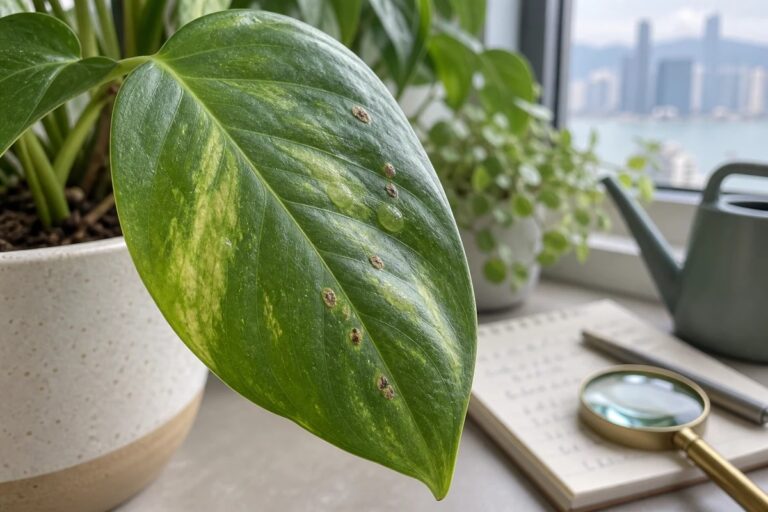
| Brown patches on white areas | Sun scorch, dry air, friction, or mineral deposits | Check light intensity and humidity |
| Yellowing after watering | Soil too wet or root issues | Check drainage and root health |
| Poorly unfurling new leaves | Low humidity or poor airflow | Maintain moderate humidity |
| Crispy leaf edges | Low humidity or hard water | Try filtered water and raise humidity |
| Spider mites / scale | Check leaf undersides regularly | Keep foliage clean to catch issues early |
How to explain to customers
"This is one of the easier variegated Alocasias to keep — it stays neat and upright, and every leaf has its own unique pattern. Just give it good light so it doesn't lose the variegation, and don't let direct sun hit those white patches or they'll scorch."
Fun facts
Alocasia cucullata holds a special place in Southeast Asian Buddhist tradition, where legend says the Buddha once rested beneath its leaves — hence its common name "Buddha's Hand." The variegated form is especially prized because its patterned leaves are sometimes said to resemble a halo behind a Buddha statue.
Keywords
Variegated Buddha's Hand, Alocasia cucullata Variegata, Buddha's Hand plant, hooded dwarf elephant ear, beginner-friendly variegated Alocasia, upright clumping plant, heart-shaped leaf, toxic to pets, shade-tolerant
參考資料(想知來源可展開)
References
- Plants of the World Online (Kew) — Alocasia cucullata. https://powo.science.kew.org
- RHS — Alocasia care. https://www.rhs.org.uk/plants/alocasia
- Proven Winners — How to Grow Alocasia Indoors and Outdoors. https://www.provenwinners.com/learn/houseplants/alocasia
⚠️ Pet / toxicity note: Contains calcium oxalate crystals; toxic if ingested, causing oral pain, drooling and vomiting. Keep away from pets and small children, and wash hands after handling.
In-depth care guide
Introduction
Variegated Buddha's Hand, botanically Alocasia cucullata 'Variegata', is a striking cultivar of one of the oldest cultivated Alocasia species. The parent species, commonly known as "Buddha's Hand" or "hooded dwarf elephant ear," is native to tropical Asia and holds genuine cultural significance — it's traditionally planted around temples throughout Southeast Asia and considered an auspicious, protective plant in several Buddhist traditions.
The variegated form's defining trait is its yellow-green mottling, with every leaf carrying a unique pattern — some cloud-like, some blocky, some following the veins closely — giving each plant real individual character. The leaves are heart-shaped and grow upright, and mature plants reach roughly 30–60 cm, a comfortable size for most Hong Kong homes.
Because the variegated tissue lacks chlorophyll, this cultivar grows more slowly than the plain green species and needs somewhat more attentive light management — but it's genuinely one of the more forgiving variegated Alocasias available, making it a sensible first step for anyone moving beyond standard green houseplants.
Native habitat
The species is native to Sri Lanka, the Himalayan foothills, southern China, and Indochina, growing at elevations from sea level up to about 900 m in tropical and subtropical zones. It's often found near human settlement — roadsides, field margins, and around temple grounds — and tolerates conditions from partial shade to full sun depending on ambient humidity, reflecting its genuinely adaptable nature. The variegated cultivar, with its reduced photosynthetic capacity, needs more diffused light than the wild-type green form to compensate.
Light requirements
Why light matters so much for variegation
Because the white or yellow portions of the leaf lack chlorophyll, overall photosynthetic capacity is reduced compared to a solid green plant. To maintain both vivid variegation and healthy growth, this cultivar needs more light than an ordinary green Alocasia.
Ideal light
Bright, diffused light is best — gentle morning sun through an east-facing window, or light filtered through a sheer curtain. Variegated forms generally need stronger light than plain green varieties to keep their patterning crisp and vivid.
Signs of too little light
- New leaves show progressively less variegation, sometimes reverting to solid green
- Growth slows noticeably
- Leaves become thin and dull
- The plant becomes sparse and leggy
Signs of too much light
Even though variegated cultivars want more light than green ones, harsh midday direct sun will still scorch leaves — particularly the white or yellow sections, which burn more easily than the green.
Supplemental lighting
If natural light is insufficient, an LED grow light works well. Variegated cultivars typically need either closer placement or longer daily exposure than green varieties — aim for 12–14 hours a day, with the light source 25–40 cm from the foliage.
Humidity management
Ideal humidity
50–70% suits this cultivar well. It adapts reasonably to typical household humidity, but levels below 50% will start to dry out the leaf edges.
Warning signs of low humidity
- Dry, browning leaf margins
- Variegated (white) areas drying out especially quickly
- Slower overall growth
Ways to raise humidity
- Humidifier — the most effective option, especially useful in winter when heating runs
- Pebble tray — simple and low-maintenance
- Grouping with other plants
- Morning misting — a helpful supplement
Watering technique
Variegated cultivars need extra care with watering
Because reduced chlorophyll slows overall metabolism and transpiration, this plant absorbs water more slowly than the fully green species. Overwatering, leading to root rot, is the most common way collectors lose variegated Alocasias.
Watering principle
Let the soil dry to roughly half its depth before watering again — meaning the top 3–5 cm should be dry, even if slightly more moisture remains deeper down.
How to check
Insert a finger 3–5 cm into the soil; water if it feels dry. In summer this typically means every 5–7 days; in winter, 7–10 days or longer.
Water quality
Rainwater, filtered water, or rested tap water are all suitable.
Always water thoroughly
Water until it runs from the drainage holes, then discard any standing water in the saucer.
Reversion
Occasionally you'll notice a new leaf emerge fully green with no variegation at all — this is called "reversion," and is usually a response to insufficient light. Move the plant to a brighter spot; subsequent new leaves typically recover their variegation. As a general rule, always judge the plant's environment by its newest leaf.
Soil recipe
Requirements
A loose, well-draining medium that still retains a reasonable amount of moisture.
Recommended mix
- Peat or coco coir: 40%
- Perlite: 25%
- Orchid bark or pumice: 20%
- Vermiculite: 10%
- Horticultural charcoal: 5%
This blend is airier than a typical green Alocasia mix, since variegated cultivars are more vulnerable to waterlogging.
Pot choice
- Drainage holes are essential
- A smaller pot suits this plant well — it dries faster and is generally safer
- Terracotta is a good choice for its breathability
Repotting
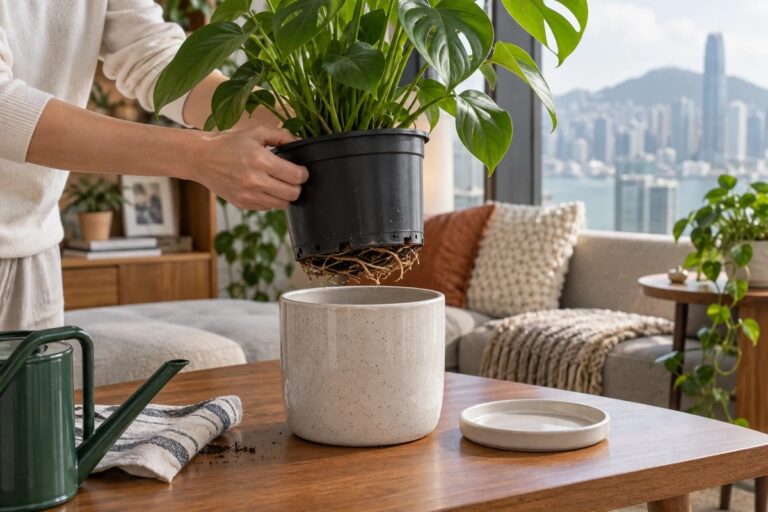
Roughly every 1–2 years. Avoid jumping to a much larger pot — increasing the diameter by about an inch is plenty.
Temperature requirements
Ideal temperature
18–27°C is the sweet spot.
Minimum temperature
10–15°C is the danger zone. This species is a little more cold-tolerant than many other Alocasias thanks to its wild-type parentage, but the variegated cultivar, being generally weaker, is best kept above 15°C.
Stability matters
Avoid locations with large temperature swings — consistency is more important than hitting an exact number.
Feeding
Timing
During the active spring/summer growing season, apply a diluted liquid fertiliser every 2–4 weeks.
Fertiliser choice
A balanced liquid formula (such as 10-10-10), diluted to a quarter or half of label strength. Variegated cultivars don't need heavy feeding — light and frequent beats occasional and strong.
Winter
Stop feeding entirely in autumn and winter.
Pruning and general care
Pruning
Remove yellowing or withered older leaves as needed. If variegated sections develop sunburn or brown patches, simply trim away the damaged portion — no need to worry beyond that.
Leaf cleaning
Wipe leaves periodically with a soft, slightly damp cloth. Clean leaves photosynthesise more efficiently, which matters more for variegated cultivars than for solid green plants.
Propagation
Division
At repotting time, offsets can be separated and potted individually.
Rhizome sectioning
The underground rhizome can be cut into sections, each retaining at least one growth point.
Common problems
Loss of variegation (reversion)
Insufficient light is the leading cause. Increase light intensity, and subsequent new leaves typically recover their pattern.
Dry leaf edges
Usually low humidity or hard water. Raise humidity and use softer water where possible.
Root rot
Overwatering is the primary cause. Variegated cultivars need especially strict watering discipline and a well-aerated soil mix.
Spider mites
More common in dry conditions. Raising humidity is the best prevention.
New-grower tips
Variegated Buddha's Hand, despite being a variegated cultivar, is genuinely easier to grow than many other variegated Alocasias. Three points matter most for beginners:
First, light needs to be sufficient. Because the variegated tissue can't photosynthesise, the plant relies on adequate diffused light for its whole energy budget. If new leaves come in greener over time, that's a clear signal to move it somewhere brighter.
Second, don't overwater. Variegated cultivars absorb water more slowly, so soil needs to stay on the drier, airier side. A smaller pot helps, since it dries out on a faster, safer cycle.
Third, keep humidity above 50%. While this plant tolerates dry air better than most Alocasias, prolonged humidity below 50% will still dry out and brown the variegated portions, hurting its display value.
Notes on variegated cultivars specifically
A few things set this cultivar apart from the plain green species:
Reversion happens because variegation is genetically unstable — sometimes a new leaf emerges entirely green. If you value the patterning, prioritise strong light; brighter conditions generally support more consistent variegation.
The white portions are more fragile. Lacking chlorophyll, they're more prone to sunburn — direct summer sun will cause brown scorch marks specifically on the pale areas, so some shading is worthwhile.
Growth is slower. With less photosynthetic leaf area, this cultivar grows more slowly than the plain green species — that's normal, not a sign of poor health.
Seasonal care adjustments
Spring: growth becomes more active — gradually increase watering and begin feeding. Watch new leaf colour as a sign the environment suits the plant.
Summer: peak growing season — protect variegated areas from harsh midday sun. Increase watering frequency in the heat, but never let the pot sit in water.
Autumn: as temperatures drop, gradually reduce watering. If growth clearly slows, start preparing the plant for the cooler months ahead.
Winter: growth largely stops — cut watering back significantly and stop feeding. Keep temperatures above 10–15°C and avoid cold drafts. If running a heater, watch humidity and consider a humidifier.
Toxicity
Like all Alocasias, this cultivar contains calcium oxalate crystals and is toxic to both humans and pets if ingested, causing oral discomfort. Keep it out of reach of children and animals.
References
- Plants of the World Online (Kew) — Alocasia cucullata. https://powo.science.kew.org
- RHS — Alocasia care. https://www.rhs.org.uk/plants/alocasia
- Proven Winners — How to Grow Alocasia Indoors and Outdoors. https://www.provenwinners.com/learn/houseplants/alocasia
- Missouri Botanical Garden — Plant Finder, Alocasia. https://www.missouribotanicalgarden.org/PlantFinder/PlantFinderDetails.aspx?taxonid=285730
For Hong Kong homes and offices. Stock and pricing follow the product page.
IN STORE NOW
Plants for this guide
Related plants in stock now — live prices, delivery or Causeway Bay pickup.
FREE PLANT ADVICE
Send us a photo before you change anything
WhatsApp a photo of the plant and your window light. Our Causeway Bay team will suggest care steps or plants that suit your space.
STORE · CAUSEWAY BAY
4/F, 39 Yiu Wa Street, Causeway Bay
Daily 12:30–8:00pm · ~3 min walk from Times Square
Map & directionsPlant Care